

Dear Parents and Carers
We are now half-way through Term 4 and things continue to be busy with the many practical and performance GCSE exams taking place. Well done to our wonderful young people for taking these so seriously and thank you to you for supporting us and them through these!
Now that the evenings are lighter it is lovely to see our young people participating in outdoor extra-curricular activities. Please continue to encourage them to get involved in as much as possible! Linked to this, congratulations to the Year 9 Rugby Team who won the South-West Region Rugby tournament in Yeovil yesterday.
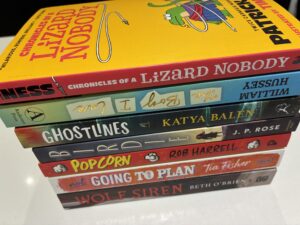
The Carnegie shortlist was announced this week, and my book bundle has arrived – I am looking forward to starting this year’s reading adventure over the Easter break!
We have the Army Band and Bugles of The Rifles in school working with some of our young people today and I am very excited to hear what they have been working on later this afternoon.
Lisa Percy
Headteacher
News Items
Focus on… Equality, Diversity, and Inclusion
At Hardenhuish, we are committed to promote Equality, Diversity, and Inclusion (EDI) to ensure that every pupil feels seen, heard, and valued.
Throughout this year, pupils have been celebrating diversity within assemblies, the Successful Lives Programme, classroom lessons, and during special events like ‘A Taste of Christmas’. Each term, pupils have the opportunity to attend Diversity Club; a student-led group that offers a space to discuss topics relating to equalities and propose ideas to promote and celebrate diversity at Hardenhuish. Diversity Club are currently working on updating their notice boards and planning a Pride Picnic. In term 5, Culture Week will offer further opportunities for pupils to experience the rich diversity within our school and around the world.
We our guided by our EDI Charter which details our ambitions for EDI within Hardenhuish and our commitment to provide an inclusive environment where every pupil is inspired to learn and supported to achieve their full potential. We are dedicated to achieving these goals through actions focused on six pillars: Curriculum, Inclusion, Respect, Culture, Leadership, and Engagement. We also set annual equality objectives to provide specific focus, which are shared in our Equality Information and Objectives Policy.
Focus on Exams and NEAs
Most GCSE and A Level courses are assessed linearly, which means all examinations take place at the end of the course. Pupils therefore sit the majority of their exams in Year 11 and students in Year 13, with no opportunity to re-sit papers before results are released. To ensure pupils are well prepared for this, we run Exam Fortnights in Years 8 and 9, as well as mock examinations in Years 10, 11, 12 and 13. These help pupils manage exam stress and practice the revision and retrieval skills needed for success in a linear assessment system.
Formal public examinations usually take place in the Sports Hall or another suitable large space and are supervised by a team of trained invigilators who ensure exam regulations are followed and pupils feel supported in a calm, consistent environment.
Some pupils will qualify for access arrangements for their exams, such as a reader, a scribe, or extra time. Eligibility depends on evidence of need and a pupil’s usual way of working. These assessments must take place within two years of the exam season, which is why testing occurs at the end of Year 9/beginning of Year 10 for GCSEs and during Years 12/13 for A Levels. Pupils with access arrangements usually sit their exams in smaller rooms enabling them to work with the agreed adjustments.
The other main form of assessment in many qualifications is Non‑Examination Assessment (NEA) — coursework or practical work completed in class under teacher supervision. Some subjects rely entirely on written exams; others include substantial NEA to assess practical, creative or investigative skills that cannot be captured in exam conditions.
Below are a small number of examples which illustrate the variety of assessment approaches across KS4 and KS5.
Examples from Key Stage 4
GCSE Art & Design (Eduqas)
Art is assessed mainly through NEA:
- 60% Portfolio (NEA): Practical project work across Years 10 and 11, showing experimentation, research and refinement.
- 40% Externally Set Assignment: Released in January of Year 11, culminating in a supervised 10‑hour practical exam.
This course is ideal for pupils who enjoy ongoing, creative project work.
GCSE PE (OCR)
A blend of theory and practical skills:
- 60% Written Exams: Covering anatomy, physiology, socio‑cultural issues, psychology and training principles.
- 40% NEA: Performance in three sports plus a performance analysis task.
This subject suits pupils who are committed to sport both in and out of school.
Examples from Key Stage 5
A Level Geography (Edexcel)
A mix of examination and independent investigation:
- 80% Written Exams across three papers.
- 20% NEA: A 3,000–4,000 word Independent Investigation based on fieldwork completed in Year 13.
This provides valuable preparation for university‑style research.
A Level English Language (AQA)
Predominantly exam‑based with a small coursework element:
- 80% Written Exams, assessing language analysis, child language development and language diversity/change.
- 20% NEA: A language investigation and an original writing piece with commentary.
This combination rewards both analytical precision and creative skill.
Where to find full details
A full breakdown of assessment methods for every subject — including exam formats, NEA requirements and exam board information — is available in our Key Stage 4 Options Booklet and Sixth Form Prospectus, both accessible via the school website.
If you have further questions about your child’s assessment pathway or how best to support them, please contact their subject teacher or tutor.
Wiltshire Youth Council Open Ceremony

This Saturday, Cullin, Scarlett and I attended the Wiltshire Youth Council ‘Open ceremony’ in Trowbridge, to meet with the 38 other newly-elected youth councillors from all over the county, and to be introduced to our new roles. We were given a warm welcome by the Leader of Wiltshire Council, Cllr Ian Thorn, as well as key members of the council’s cabinet, who gave us a fascinating insight into their roles and responsibilities. We then had the chance to engage with the representatives of the area’s various other schools, analysing and discussing young people’s top priorities and how to address them over the next two years. The event was also a unique experience to run for two more exciting roles: Head Secretary of Wiltshire Youth Council and Member of Youth Parliament for Wiltshire North. I am pleased to say that Cullin and myself were successfully elected to these respective roles after an afternoon of brilliant speeches from all of our fellow candidates from across Wiltshire.
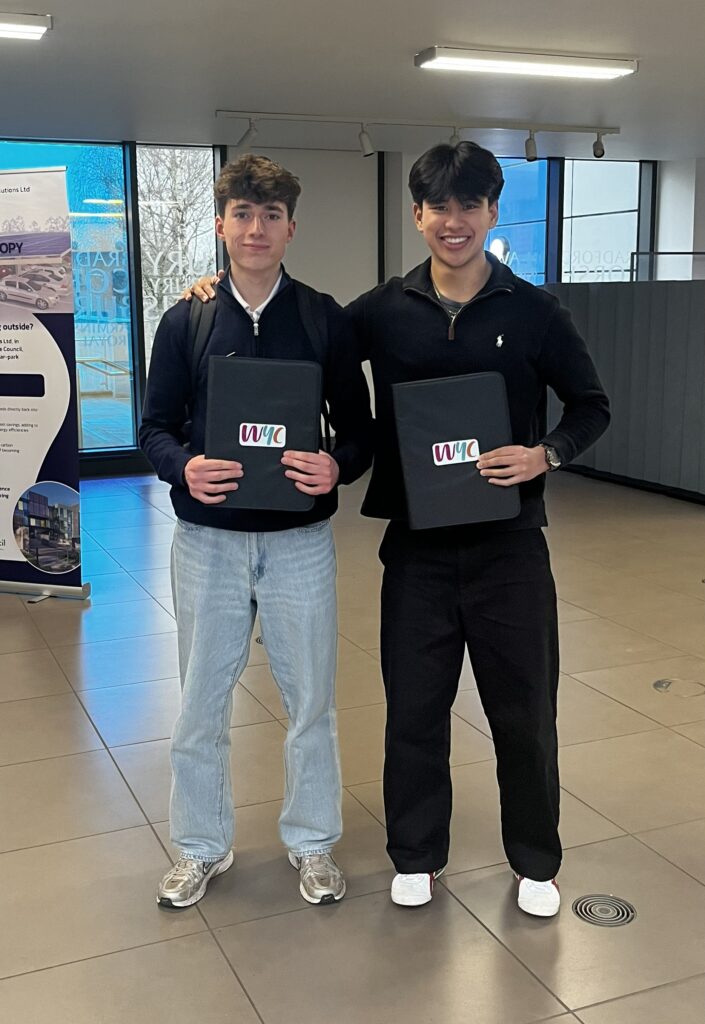
Louis Sabatier – Member of Youth Parliament for Wiltshire North and Year 12 School Parliament Representative

Student Correspondent
This week, Year 12 student Cullin Pangilinan had an article published in The Bath and Wiltshire Parent. Cullin is a member of our School Parliament and has recently been elected as one of the Wiltshire Youth Councillors for Hardenhuish. His article highlights some of the exciting ways we have been exploring politics and democracy at Hardenhuish this year. Read the full article here…
Hardenhuish students explore politics and democracy
Fidget Tools – Information for Parents

At Hardenhuish, a small number of pupils use fidget tools to support their focus and concentration, reduce anxiety, or help with sensory regulation. These tools are not toys, but purposeful items that can make a positive difference when used correctly.
We’d like to share our approach so families are aware of how we manage fidget tools in lessons:
Our Expectations
- Fidget tools should be quiet and used discreetly.
- They must support learning, not distract the pupil using them or those around them.
- Noisy, visually stimulating or “toy‑like” items (e.g., pop‑its, clickers, spinning toys) are not suitable for use in lessons.
Agreed Use
- For some pupils, a specific fidget tool may be recommended by an outside professional or agreed with parents and the SEND team.
- Where this is the case, this information is shared with staff.
- Even with an agreed tool, pupils must still use it appropriately and in a way that helps rather than hinders learning. If this is not the case then staff will ask pupils to use it appropriately or may ask for it to stop being used.
Flexibility When Needed
- There may be times when a quiet, appropriate fidget tool is helpful for pupils who are not formally identified with additional needs. Staff will use their professional judgment to support this as appropriate.
We want to ensure that all pupils learn in a calm environment where everyone can focus. When used well, fidget tools can support regulation, concentration and wellbeing. When they become a distraction, staff will work with pupils to find a more suitable approach.
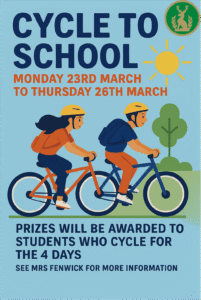
Students are invited to take part in a fun and energising Cycle to School event running from Monday 23rd to Thursday 26th March, as part of the school’s wider sustainability initiative. It’s a great chance to get active, reduce your carbon footprint, and celebrate greener ways of travelling to school.
🚲 How to Take Part
- Cycle to school on any day between 23–26 March.
- When you arrive, lock up your bike in 1 of 5 bike parking racks, then head to the E‑centre foyer and meet Mrs Fenwick.
- Show proof that you cycled — either a selfie with your bike or simply your bike helmet.
- You’ll receive a stamped card, plus a cereal bar and a hot chocolate as a thank‑you for taking part.
🎁 Prizes to Be Won
Collect stamps each day you cycle. Students who return a fully stamped card will receive a prize on Thursday 26th March.
🌍 Supporting Sustainability
Cycling to school is a brilliant way to support our commitment to sustainability by reducing traffic, emissions, and congestion around the school site. While we understand that cycling isn’t possible for everyone, we hope to see as many students as can safely take part.
It’s a great opportunity to enjoy the fresh air, try something new, and help make a positive difference. Will you join us for Cycle to School Week? See Mrs Fenwick for more details.
Vacancies – Hardenhuish School
Our Community – Hardenhuish School